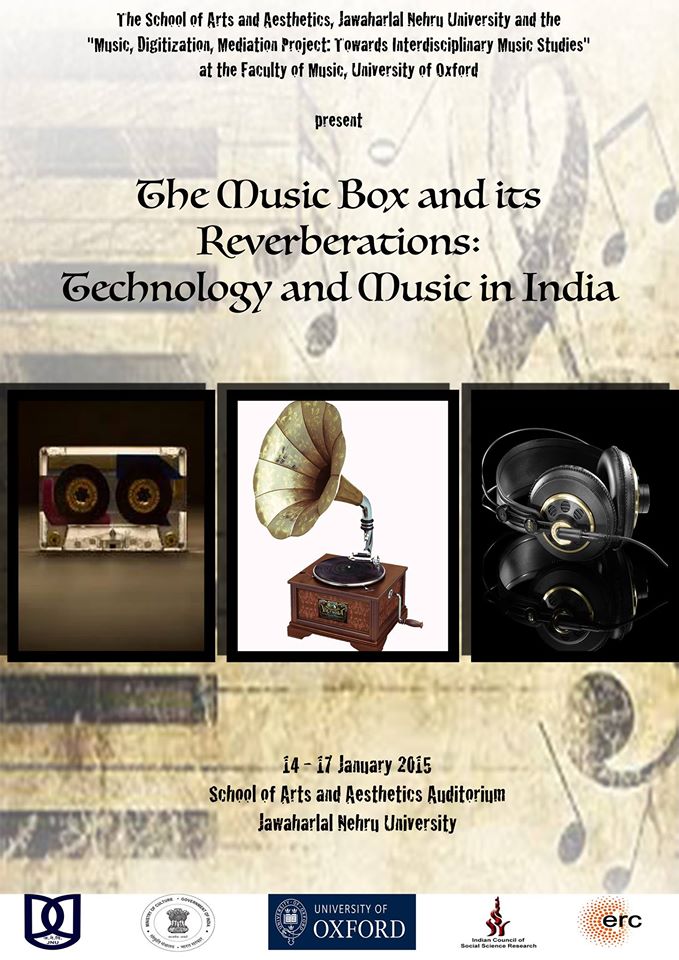
Wed, Jan 14, 2015, 03:30 PM - Sun, Jan 18, 2015, 02:00 AM
International Conference
14 - 17 January 2015
School of Arts and Aesthetics, JNU
Concept Note
The explosion of digital technologies for sound in the past two decades has thrown into sharp relief the tangled mediations of the musical, the technological, and the social-institutional. As a medium for aesthetic creation, the digital facilitates processes such as sampling and remixing that confuse popular notions of authorship and originality in music. The particular materialities of digital circulation, reproduction and storage of audio have simultaneously impacted established music industry norms and subjective engagements of listeners with ...music. Indeed, the digital’s blurring of existing practices of creativity, circulation and listening draws our attention to music as a sonic-social-technological
This conference enters these discussions from the vantage point of India, taking the opportunity to rethink claims about the digital and its precursors through India’s particular combination of several musical forms and technologies in modernity. We begin from the coordinates of ‘popular’ music (film, vernacular) and ‘classical’ music, aiming to open up routes that probe technologies as they intersect with questions about definitions of categories, re/configurations of genres, musicians’ livelihoods and music industries (especially popular music industries), and affective engagements of musicians and audiences. For instance, for music that continues to be associated with oral circulation — specifically, the regional/vernacular and the classical/art — technologization has been perceived as a singular mode of recording for posterity while simultaneously inciting anxieties about the loss of the ‘liveness’ central to their performance and transmission. The digital, in these contexts, is emphasized through its seemingly infinite possibilities for archiving and dissemination, and an ever-increasing attention to the ‘live’ aesthetic. In contradistinction, with digital production tools, music genres that are ontologically technological — for instance, Hindi and Bhojpuri film songs, remixes, Indipop — have explicitly embraced new generic formations, and sonic and musical textures. Further, if it accentuates certain kinds of differentiation, the digital also flattens production hierarchies and differences by promoting new kinds of industry and engendering new modes of listening.
Organized collaboratively by the Music Digitisation Mediation project based in the University of Oxford, UK and the School of Arts and Aesthetics, Jawaharlal Nehru University, New Delhi, India, the conference uses these lenses to trace musical experiences in the Indian context as they are mediated by technologies of music production, circulation and consumption. Choosing to concentrate on the aural as against the audiovisual (following Ochoa Gautier 2006), we draw upon scholarship from several disciplinary orientations to focus on selected domains of the interfaces between sound socialities and musical technologies. We aim to bring together perspectives from academics and practitioners through papers, roundtable discussions and performances. We propose the following themes, without being limited to them:
● Sonic technologies, aesthetic regimes and the crafting of genres/categories
● Technologies, digitization and film music industries
● Individuals, institutes and processes of collecting, storing and archiving music
● Amplification, circulation and the creation of musical/sonic publics
● Enmeshed technologies of the object and listening subject/s and practices
● Musical livelihoods, economies and sonic technologies
Each conference evening will culminate in a performance/ concert that will speak to the several musical practices that we use as an organizing schema. These eminent musicians/ artistes include Carnatic classical vocalist Bombay Jayshree, musician and music archivist Moushumi Bhowmik and Arijit Dutta.
Conference committee
Prof Georgina Born (University of Oxford); Prof Ira Bhaskar (Jawaharlal Nehru University); Prof Bishnupriya Dutt (Jawaharlal Nehru University); Dr Kaushik Bhaumik (Jawaharlal Nehru University); Dr Aditi Deo (Indian Institute of Science Education and Research Pune); Vebhuti Duggal (Jawaharlal Nehru University); Anubhuti Sharma (Jawaharlal Nehru University)
For any queries: please email saamusdigconference2015@gm
Fri 23-Nov-2018
Mon 20-Mar-2023


To stay updated with your interests and events
