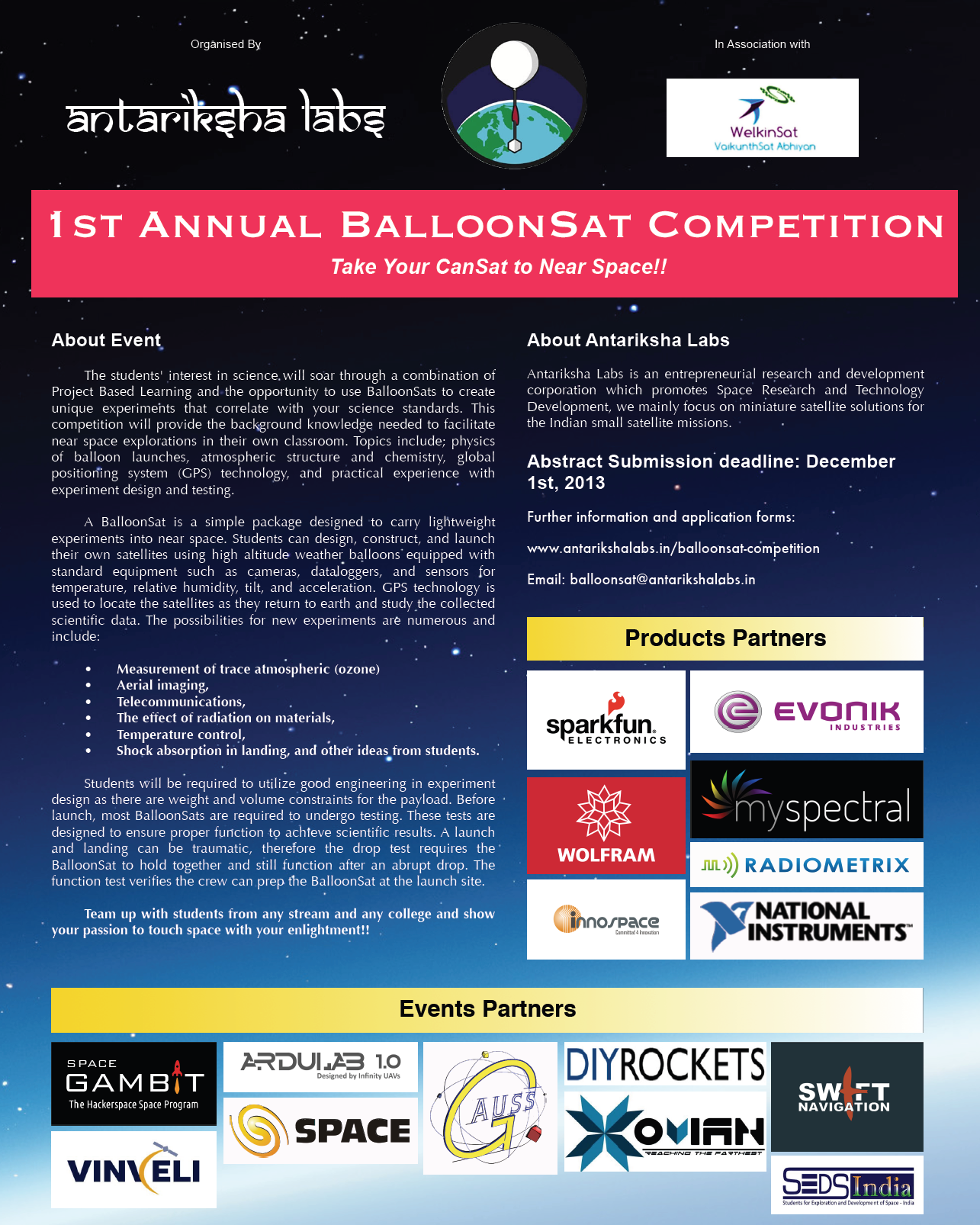
Sun, Nov 10, 2013, 05:30 AM - Thu, Jul 31, 2014, 05:30 AM
http://antarikshalabs.in/balloonsat-competition
About BalloonSat
BalloonSats are a relatively easy way to get experiments off the ground and into our upper atmosphere i.e. near space. With BalloonSats, we can learn about space physics and engineering, test equipment for future space flight, conduct interesting experiments, take pictures and video from up to 30480 meter in the air (more than three times the height of Mt. Everest) and more!
This competition will provide the background knowledge needed to facilitate near space explorations in their own classroom. Here you will get to learn about how to proceed on like a conceptual satellite design phase gearing you up for future missions. Your module require work into various departments like Attitude Determination and Control System, Command and Data Handling, Ground Station & Telemetry, Housekeeping & Descent Control, Power Unit and Circuitry, Structure and Payload Health Unit, Integration, On Board Computing And Software, Fault analytics and Management. It’s a multi-disciplinary project involving all the departments of engineering and certainly will take you further into building space missions.
Quick Guide
•The team is required to design the entire module comprising of systems like Payload Unit, On Board Computer & Software Development, Telemetry & GPS Tracking, Command & Data Handling, Ground Station Control, Housekeeping & Descent Control, Power Unit & Circuitry, Structure & Payload Health Unit and others related.
•The payload idea and design has to be done and procured by your team which will later be mounted on your fabricated structure model. We are looking for interesting and unique payload idea and the most innovative experiments will make it to top teams for the launch.
•The first step of the launch is to attach the parachute apex point with the hydrogen /helium filled balloon’s shrouds which will take your structure/payload to near space.
The BalloonSat structure-payload (Cylinder of 20cm diameter-30cm height & 1kg weight) will be attached to the primary parachute’s shrouds.
•Upon reaching the final countdown and after launching, the Tracking team has to start monitoring the trajectory of the BalloonSat and follow its trail after the launch for the recovery using GPS trackers, ground station data and radio data. Remember, module can go beyond 50km and you need to have a private taxi with you to recover it and your transmission module has to work to let you launch your module.
•After the crossing of 20 km altitude, the command has to begin for main payload work initiation which carries the maximum marks for the event. No negative for initiating general sensor data capture from launch period.
•Right after the balloon bursts upon reaching maximum expansion point(30-40km), the role of the descent system begins where the descent rate has to be maintained between 20-25 m/s using parachutes designed by you. Upon descending to an the altitude on 200m, the secondary descent system like parachutes, parafoils, streamers etc. need to eject reducing the drop rate to 2-5m/s.
•The temporary locating beacon i.e. the buzzer has to be of very high intensity and should initiate after crossing 200m mark. The parachute color also should be selected properly so that the module can be located visually very easily.
•After successful recovery of the module, the team need to get back to launch site for data collection and after that the team will be given 1 day time to prepare the Post Flight Review.
•Collective marks of Preliminary Design Review, Critical Design Review, Launch Achievements and Post Flight Review will decide the winner of the competition.
Abstract Submission Rules
Important factors in developing a winning proposal with a high probability of completion include:
•Quantifying expected behavior.
•Demonstrating that the effect can be measured or observed.
•Planning for pre-flight testing to verify successful operation during the flight.
•Planning how to analyze the resulting data.
•An experiment: with a hypothesis to test, usually with controls and a conclusion about the validity of the hypothesis.
•An observation: establish how the observation will be quantified with sufficient precision and accuracy.
•A demonstration: design a way to accomplish the task.
Proposal Components Teams must submit a proposal containing the sections listed below:
1. Abstract
2. Scientific/Engineering Objectives
3. Technical Plan
4. Payload Design & Goal
5. Structure Description
6. Telemetry & Tracking Plan
7. Electronics & Electrical Design
8. Descent Control
9. Team Organization
10. Questionnaire
11. Resource credits
Fill in the form of "Intent for Participation" @ https://docs.google.com/a/antarikshalabs.in/forms/d/
100l4eziPmJyEDCPgNlA3R795ZnrS1U6u6yPpQEjAYys/viewform and we'll keep you updated with new information.
Submit the proposal via email to: balloonsat@antarikshalabs.in
Team composition
Students currently pursuing their undergraduate degree programs are eligible to participate in the event. A joint Students team from two or three different colleges is allowed upon mutual agreement. A team should comprise of minimum 4 and maximum 10 students.
It is recommended that students form a team with mix of each departments related as this is complete multi-disciplinary project. A Faculty Advisor is needed in the tam whose role is to set an co-ordination aspect in the team, team logistics, arranging labs for experiment and resources, management etc.
A Team Mentor will be assigned to every finalist who would solve your technical problems and other co-ordination related things for the event. The Team mentors would be professionals, scientists and experts from various recognized organizations who will give you enough knowledge for the level of competition and technical solutions.
Agenda
Qualifying Abstract Submission - December 9th, 2013
Preliminary Design Review - February 2nd, 2014
Critical Design Review - May 4th, 2014
Tests: 1 week before Launch dates
Launch & Post Flight Review - June-July 2014


To stay updated with your interests and events
